Another year

Well, I don’t need to tell you – it’s been a year. In my corner of the world it featured – among other things – one climate disaster after another, a reckoning with the atrocities of a genocidal residential school system, and of course of course – the pandemic. As it stands now, in the final days of 2021, we are experiencing levels of uncertainty remarkably familiar to the feelings of March 2020. Everything old is new again.

I’ve considered writing about the pandemic. About how it’s revealed the cracks in every one of our systems – social, economic, health, education, etc. About the uncertainty and the complexity that characterize it, and the challenges we have contending with both. I’ve thought about dusting off my masters thesis on the media coverage of SARS, the 2002 early run-through pandemic that didn’t amount to much in the end (Wikipedia tells me there were 8,096 confirmed cases, total). But I can’t stomach it. Not yet. Maybe next year. It’s enough to just live through it for now, and I’m tired.

As it stands, instead of contemplating the big picture, my reflections on 2021 return again and again to the smallest things, the things that rose to the surface of a year that seems in retrospect to have lasted a decade but flew by as quickly as any other. I think about the time I was able to spend by and in the ocean. My daughter’s delight as she got her first real taste of big waves and what they can do to your fragile human form. About the profound sense of fulfillment I experienced while collaborating with professionals who are uniquely dedicated and passionate about improving the lives of others. I think being adjacent to the best humanity has to offer was a salve to witnessing profound levels of selfishness and entitlement from people who were being asked to do so relatively little.

I think about the time I decided to heed my therapist’s advice that, if sitting still and breathing and being along with my thoughts was not my cup of tea, I could seek mindfulness in other ways. So while we were on vacation I decided to pay very close attention to the enormous west coast slugs that congregated around the house in the morning. My daughter was fascinated by them. She made them little worlds with sticks and stones and asked so many questions. I used to be that curious about things but lost the instinct for a while. Maybe it’s coming back. I made the delightful discovery that if you have average hearing and really, really listen, you can make out the sound of a slug chewing on a leaf.

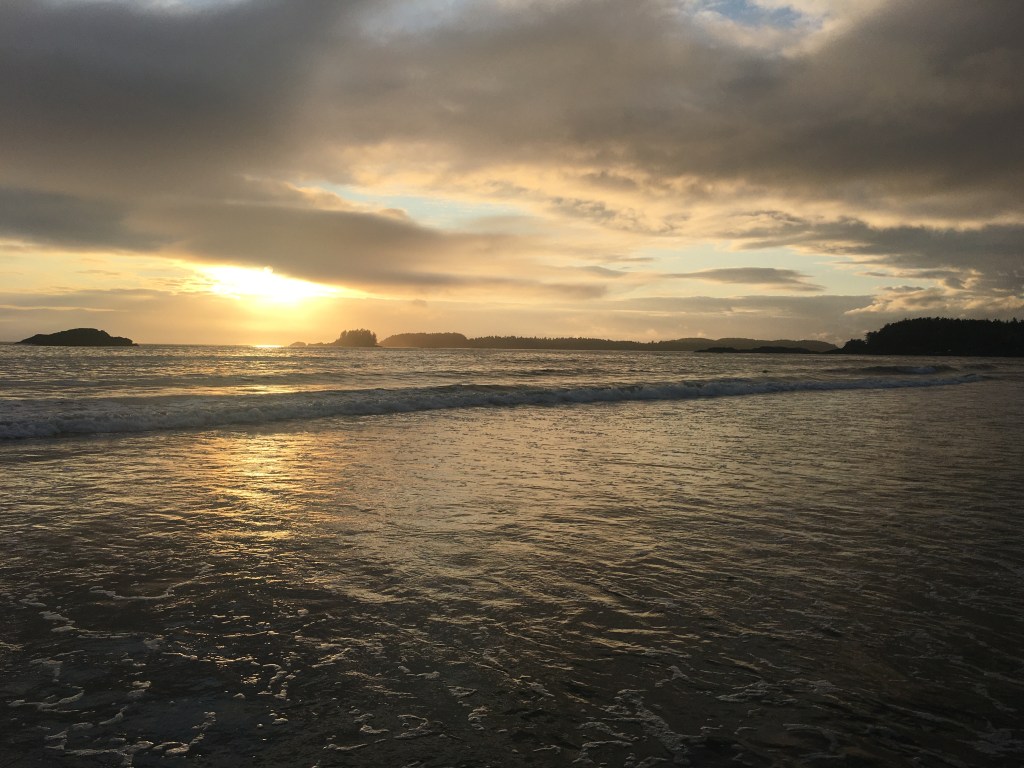
I think about my last night seaside, when I walked into the low tide into water up to my knees and took in the sunset. The water seemed warmer than normal for the Pacific. At the time I though back to living through the heat dome and how horrendous it was – physically and existentially. Maybe I’m just that dog in the cartoon, I thought, sipping his coffee and saying “this is fine” while the room burns around him. But at that particular moment, surrounded by water, it was fine.

What these things have in common is connection – to people, or a sensation, or a cause, or a humble invertebrate just going about its business. They were moments when I was fully present and not distracted by a phone or a feed or my very smart watch. I’m not going to lecture you about the perils of technology or the promise of digital minimalism. I will, however, recommend an article that’s helped me reevaluate how I integrate social media and my gadgets into my life, and to remind myself of just how rapid and profound the changes brought about by smart phones and social media are. In I Used to Be a Human Being, prolific blogger and social media user Andrew Sullivan contemplates the “distraction sickness” that nearly drove him into the ground, situated within a broader discussion about the social impacts of our most recent technological revolution. I’ve posted three blog posts this year and may have tweeted just as many times; clearly, I am no Andrew Sullivan. But I admit to having absolutely no self-control when it comes to consuming information and entertainment, and as I’m sure you’re aware, there’s a lot of it available these days. As Sullivan becomes completely overtaken by his online life he notes:

I began to realize, as my health and happiness deteriorated, that this was not a both-and kind of situation. It was either-or. Every hour I spent online was not spent in the physical world. Every minute I was engrossed in a virtual interaction I was not involved in a human encounter. Every second absorbed in some trivia was a second less for any form of reflection, or calm, or spirituality. “Multitasking” was a mirage. This was a zero-sum question. I either lived as a voice online or I lived as a human being in the world that humans had lived in since the beginning of time.

I don’t begrudge myself my distractions, especially not this or the previous year. The tiger kings and the twitter doomscrolling, the Instagram feeds, the Sunday football games and the many, many seasons of Drag Race (honestly, far too many.) And I won’t downplay the value of connecting online, for bringing people together and forging relationships. I know there have been times when it’s been a lifesaver for me. But for 2022 I would like more moments of curiosity and less consumption. More being in the place I am, and not splintered simultaneously into far-flung corners of the electronic universe. And of curating the distractions more carefully so that my ability to do deep, focused work is strengthened. When it comes down to it, maybe I just want less. Less information, less stimulation. More calm. To maybe learn to sit and focus on my breath as much as it seems to pain me to do so. To do so requires making room. So I am assigning value to the various distractions, determining what stays and what goes. It’s the closest thing I have to a resolution.

So with that I wish you the best for 2022, whichever version of ‘best’ works for you given the circumstances. I leave you with this picture – my final night of staring into the sunset. I took a picture as a token and a reminder that sometimes, everything is fine.

I’ll post it to Instagram.
One foot in front of the other

This is an essay about walking during the pandemic.

I’m certainly not the first to write about the topic. Far more clever folk than I have reflected on how the pandemic has helped us to relearn the the “lost habit of walking,” turned us into “Victorian children” needing daily air and exercise, and presented us with opportunities to see everything old as new again within the 15 block radius of our homes. My own trajectory of pandemic walking is incredibly typical. I initially embraced my walks as a means of maintaining health and sanity, of building routine into formless days and forcing myself out of the house when all of my usual obligations had fallen away. I found new routes – previously unexplored laneways, a local ravine, hidden fish ponds and a graveyard with views of the Fraser river and Mount Baker. Like many others, the first few months of the pandemic were signified by wildlife sightings. Several families of raccoons, an adorable group of baby skunks (which I learned are called a surfeit), baby rabbits, swooping bats, if I timed it right at dusk. And coyotes. It became a running gag for a group of local friends – the coyote sightings posted on the community Facebook page by people who didn’t quite understand that the coyotes have always been here. It would seem that many of us were made to experience where we live on a level we had somehow managed to avoid in the before-times.

I am profoundly grateful that I have my mobility and am able to walk. I suffered a minor knee injury just prior to the first lockdown, and I remember clearly the low grade panic I felt, knowing on some level how important walking was going to be in the upcoming weeks (I doubt I understood that this would actually mean months). I have flirted with athleticism at various points of my life, but walking has always been my constant companion and one of my great loves. Luckily, the injury wasn’t serious and I was able to build back up to a regular routine. I am also grateful to live in a place conducive to walking, with tree-lined streets, adequate sidewalks, access to a small patch of woods and the aforementioned views of a river and mountains. So please believe me when I tell you that I am still grateful for these things, but am also so, so sick of walking — of what Jenny Singer hilariously refers to as the “year of nothing but dumb little walks.” As it turns out, at least part of my love of walking is tied to my love of seeing new places and things, ideally in new locales.

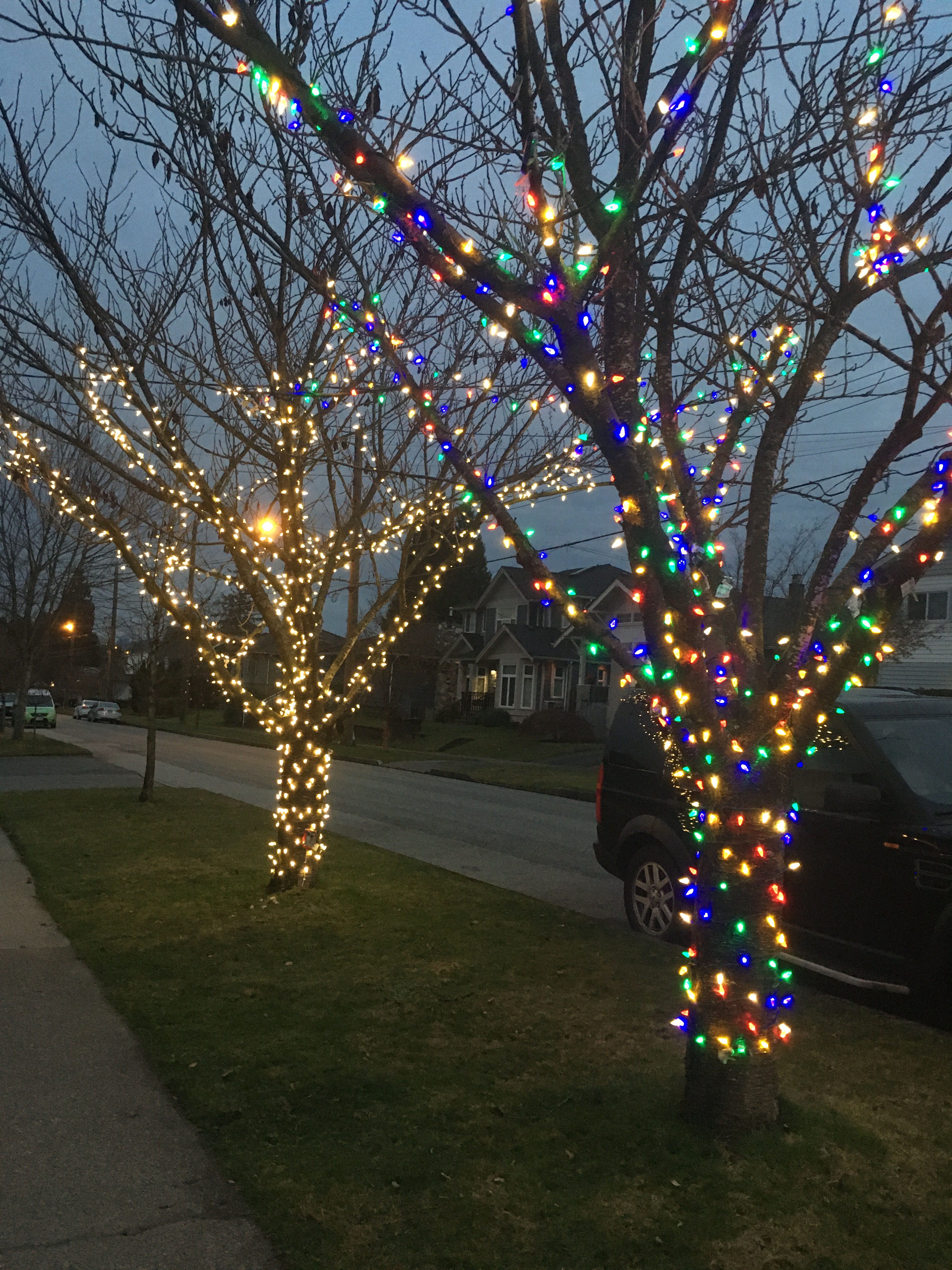
Thankfully, I discovered a new love this winter — Christmas lights. I’ve never not liked Christmas lights, but this year I’ll admit to becoming obsessed with them. The lights went up early, and stayed up well past what would normally be considered acceptable. I have no empirical evidence to support this claim, but it feels like more people put them up. They came in all sorts of hues, shapes and sizes. They ranged from single, humble strings to extravagant, garish displays. I had room in my heart for all of them. I fell deeply in love with some in particular. A tree decked out in pastel coloured lights that seemed impossibly warm and inviting. Some newfangled things called “starlight spheres” — big bold colourful balls that hung from tree branches much like indoor ornaments would. And my two favorites – trees halfway down my street, trunks and branches blanketed in light. The white ones went up first, their brightness a brazen reply to long winter nights. I was genuinely delighted when the second tree was similarly accessorized, but with colour. Together they made a handsome pair, and I did not take them for granted, making sure to lay eyes on them every night, even if only meant stepping out onto my front porch to do so.

A picture that does neither the trees nor lights justice

When I think about the Christmas lights and why they were important to me (above and beyond the obvious benefits of seeing light during our darkest days) I think about Ellen Cushing’s fantastic essay “Late-Stage Pandemic is Messing With Your Brain.” Cushing reflects on the mild cognitive impairment that results from experiencing prolonged bouts of boredom, with an underlying exposure to stress. Our brains revel in novelty — the “environmental enrichment” that comes from interacting with different people and places over the course of our day-to-day lives. I think the Christmas lights helped fulfill this deeper function. I couldn’t sit in a coffee shop and work while people watching, but I could develop a mental map of my surroundings based on the lights and lights alone, and push myself further afield to locate new entries. As the lights started to go out, my walks became singularly focused on finding the last stragglers, scanning streets and walking routes that would seem haphazard to an outsider but that contained an internal logic all my own.

Unfortunately, the humble Christmas light can only do so much. Even though many of them remained up well into March, I stopped walking, hobbled not by a bad knee, but by a mind dedicated to the craft of unreliable narration, and a body invested in the thoughtful remembrance of traumatic anniversaries. While the dog days of winter are never an easy time, this year was worse than others. Perhaps I can blame late-stage pandemic living for this as well. The loss of the regular routines that serve as at least a partial buffer to an excess and time and space to live with ones thoughts.

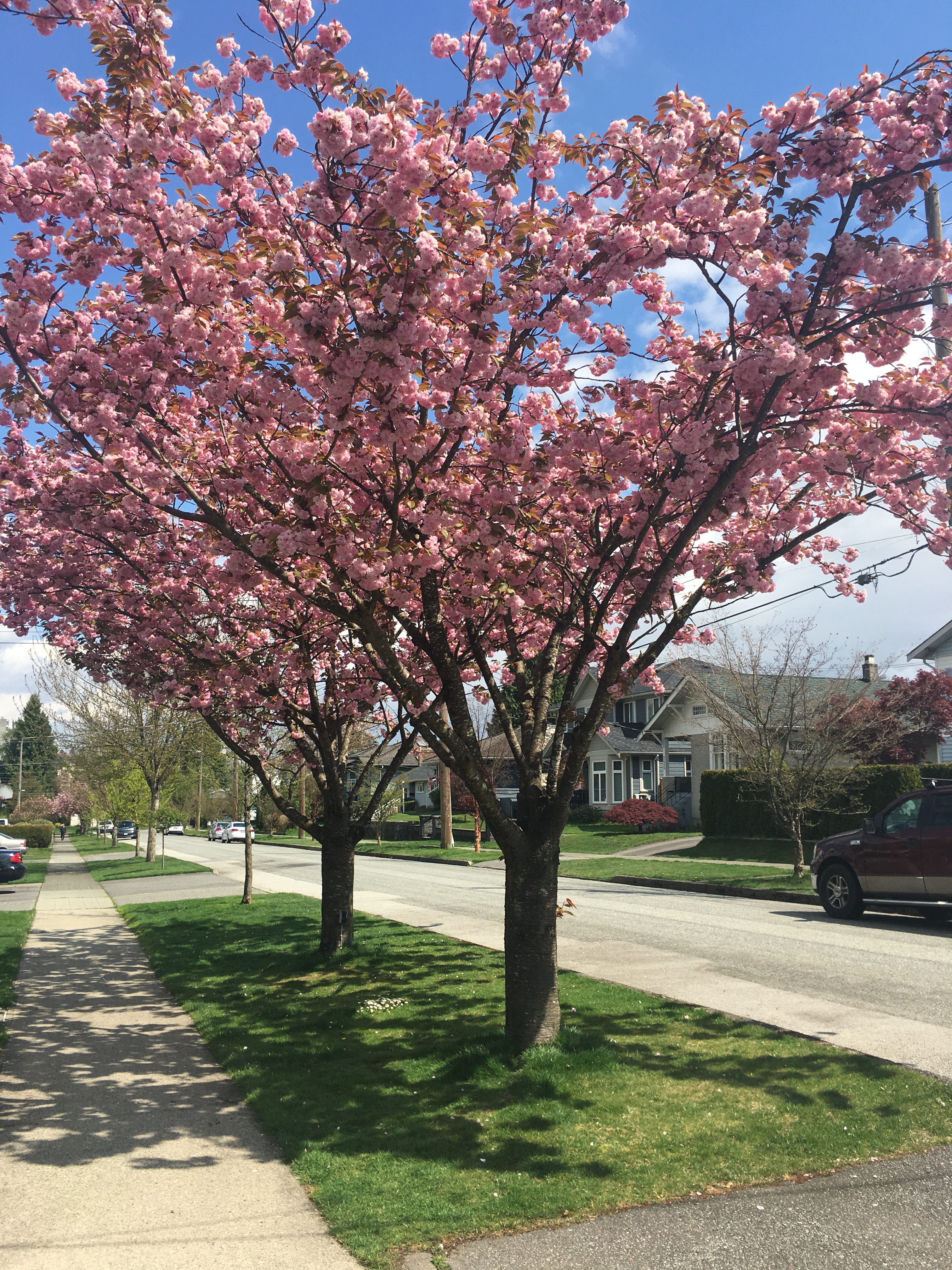
But the pandemic, and the weather, both giveth and taketh away. March passed and winter ended. The days grew longer and we saw the sky. Things settled down in my body and mind, as they mercifully tend to do. I had time and space to dedicate to recovery in a way that felt different, and significant. I listened to music that brought me joy. I met with friends who brought me comfort. One day I found myself mapping out my upcoming year, and paused in realization of the significance of this — of being able to project ahead with a sense of hope and excitement. The trees in my neighbourhood blossomed. I don’t know exactly when the lights on my two favourite trees went out. Probably sometime while I was laid up at home, incapable of opening the front door to check on them. It’s ok though – the bulbs have been replaced by an explosion of pink petals. I don’t know that I ever realized they were cherry blossom trees. I’ve noticed this year. I’ve seen them on my daily walks.

Resolutions in the Age of Overwhelm

One Wednesday, back in November, I sat down for my weekly online lesson in American Sign Language. The instructor signed hello to each of us and asked how we were doing. Normally I would rely on my basic sign vocabulary to answer “good,” “fine,” or some other common nicety. I must have been feeling particularly honest that day, because I made the effort to awkwardly fingerspell the word “overwhelmed.” Nodding, my instructor held her hands in front of her, palms facing her body, fingers pointed towards each other. In one swift movement, she lifted them over her head. This gesture, combined with an appropriate facial expression, forms the sign for “overwhelmed.”

ASL Instructor Dr. Bill Vickers demonstrates the sign for overwhelmed. (ASL University)

A few weeks later, I failed to show up for my final ASL class. I had been struggling to make it to them due to my work demands and other commitments, but this wasn’t planned. I had looked at my calendar early in the day and made a mental note that the lesson was coming up at 3pm. Usually, this would suffice. But that evening as I crawled into bed I realized I had forgotten all about it. More significantly, at some point I had forgotten what day of the week it was.

* * *

In retrospect, it seems like one of those odd little coincidences that a friend reached out shortly after this incident to inquire about a book she had loaned me months ago – The Age of Overwhelm: Strategies for the Long Haul. When she gave it to me I had warned her that I would take ages to read it, if I ever even did. She assured me this was fine, there was no rush. And true to my word, I hadn’t cracked it when she messaged me. She assured me there was still no rush on returning it, but I declared that I was going to read it over the holiday break, in part because of that whole coincidental timing thing. Signs from the universe, and all that.

The Age of Overwhelm is written by Laura van Dernoot Lipsky, founder and director of The Trauma Stewardship Institute. Over the course of the book Lipsky lays out what it means to be overwhelmed, at both an individual and societal level, drawing upon personal experiences and the thousands of hours spent working in trauma-informed practice. Her strategies for action are (to her own acknowledgement) nothing earth-shattering, representing a return to ancient practices with some modifications in line with modern concepts of basic self-care. Taken together, they are best summed up by her advocating for you to do more of what sustains you, and less of that which erodes you, within the constraints of the conditions you find yourself in. The brutally difficult trick of this, though, is existing in a state of awareness that leaves you available to tell the difference between the two. Even when things are going well, we live in an unprecedentedly complex environment that challenges our decision-making availability and overwhelms us with information. Lipsky’s recommends common strategies for navigating this environment but frames them in light of their power in staving off overwhelm rather than as efforts to lead our most productive lives. It’s a nuanced but effective shift. The greatest strength of Lipsky’s work, however, may be her ability to communicate what being overwhelmed feels like, and the toll it takes on ourselves and those whom we are responsible to. She conveys the differentiation between feeling tired, run down, or over-scheduled, and the state in which “your own day-to-day life feels like a lot, and your very well-being is at stake.”

The Age of Overwhelm was published in 2018, but felt like an especially timely read at the close of 2020 – a year that, for reasons you do not need me to recount here as they are likely uniquely ingrained into your own nervous system – felt like the poster child for the condition. I was in my own personal state of overwhelm during the early days of the COVID-19 outbreak. There were obvious causes – a world-wide pandemic, questions about school closures, and insecurity around recent employment. But underlying – or perhaps surfaced by – all of these was a post PhD defense crash that I was not prepared for. Having barely dragged myself to the finish line at the end of 2019, I had naively imagined I would find myself lighter at the outset of 2020 – unburdened by the weigh of a difficult task completed under difficult circumstances. What I did not anticipate was what the task had taken from me when it left. I was experiencing a profound sense of depletion – an emptying out of reserves, stamina and any ability to deal with what life had to throw at me. Like many other folks, I set goals for myself at the outset of 2020 that seem wildly laughable in retrospect. We plan, god laughs – so the proverb goes. I didn’t realize that 2020 would, in actuality, be an exercise in reserves replenishment. As Lipsky notes:

There is value to us fostering stamina so we can move through our days with more levity and more confidence that we can tend to whatever may arise. Additionally, when the unexpected arises and requires us to find that gear we’re not sure we have, having reserves, having a baseline that isn’t collapsed, having some stamina, can make a huge difference in how we fare managing our saturation or keeping overwhelm at bay. Remember, less is more.

The strategies Lipsky recommends for dealing with depletion – one particular manifestation of overwhelm on a broader continuum – include focusing on that which is within our control, building in regular daily routines that reduce decision-fatigue, practicing mindfulness and learning when to step away from situations or relationships that fail to sustain. In other words – simplify, simplify, simplify. The pandemic lockdown likely helped me in this regard. Many of my usual obligations, distractions, and points of decision-making have been made unavailable. I have been forced to sit with my depletion, understand it for what it was and take tenuous steps towards rebuilding my baseline.

* * *

If present-me could speak to past-me, embarking on 2020 with a misplaced sense of optimism, I’d tell her to consider the gift she’d just received from her partner. It’s a beautiful framed photograph titled Haenyo Emerging for Air, taken by Ian Baguskas. It depicts a form clad in a wet-suit, shoulders and head above water in the calm open ocean, nothing but the horizon in the background. She is a member of a declining group of deep sea diving women in Jeju-do, South Korea. The photograph is a symbolic representation of us both coming up for air after an arduous phase of our lives. I would encourage past-me to focus on the photo and rest assured that, for long periods of time, it will be sufficient to merely stay afloat. That the time for deeper dives is coming, and, when all else fails, to keep her eye on the horizon. Having learned my lesson last year, I have resisted the urge to set proper goals for 2021. The SMART kind – measurable, time-sensitive, designed as a means to a productive end. Instead, I have some rough ideas of how I would like to be in the world, and how I might get there. I even resisted the urge to sign up for my regular sign language classes, a decision weighted with feelings of responsibility and, subsequently, guilt. I resigned myself to the fact that – at least in the immediate short term – I didn’t have the capacity to show up and be appropriately present. For now, I’m grateful to know the sign for overwhelmed, and hopeful that I’ll have less need to use it.